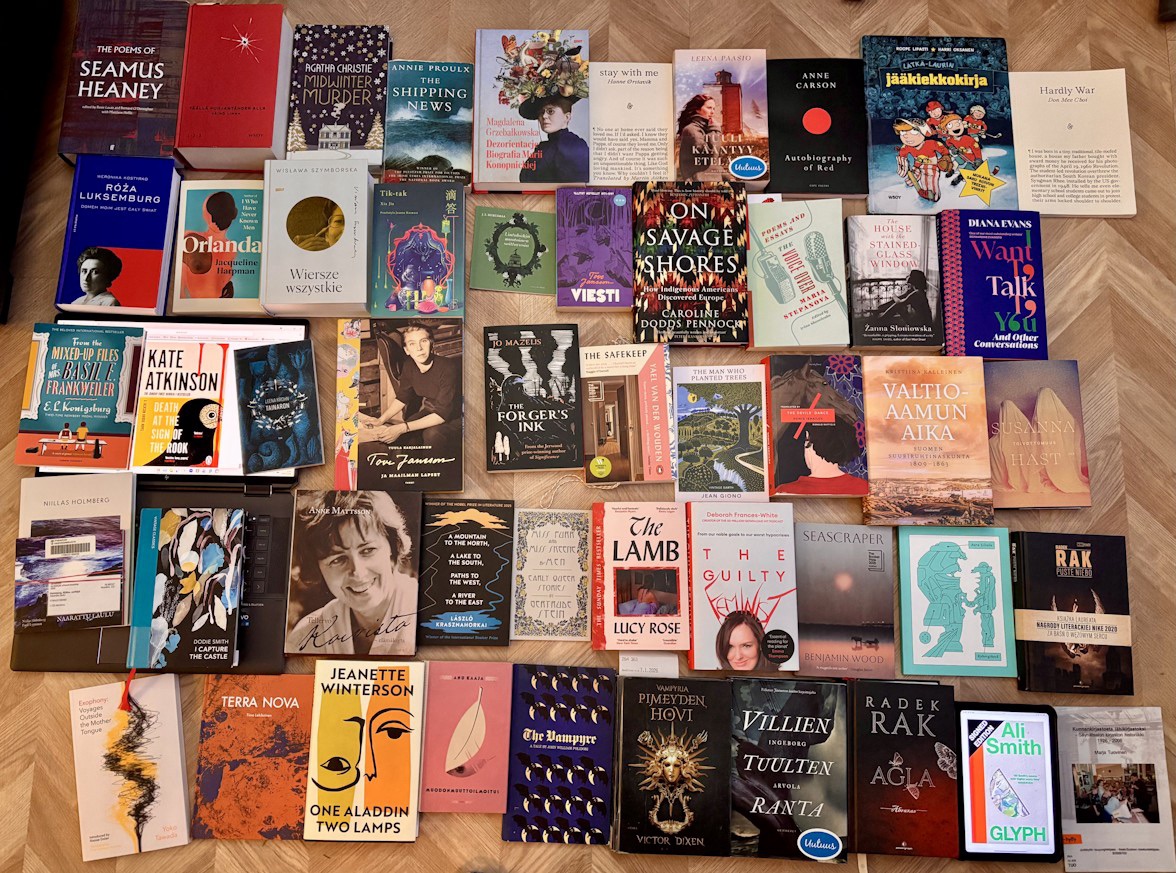
Do you do a reading challenge? This year’s Helsinki Libraries Challenge made me think again about ways to write. The photo shows what I read to fit the 50 categories this year.
I began from my TBR pile, which to quote a colleague, Isabel, can be seen from space. If I’d bought or received it, it was about time to read it. I only ordered half a dozen books from the library and only bought one new — Ali Smith’s latest, which I’d ordered when I took the photo, for the new in 2026 category. It came, it was fantastic, I’d expect no less. If any resonate with you – or not! I didn’t love them all! – I’d like to hear which ones. I noticed far more than five ways of writing, but here are the first five things that struck me.
Women rewrite history
Sometimes it takes a generation change to get to the new story – or centuries. My PhD is 21 this year (eek!). If I was writing it now, of course I hope I’d write it better, but my view of the whole field would be different. Because the conversation has moved on. Three writers I read for this challenge moved the conversation on themselves. Weronika Kostyrko shows how early Róża Luksemburg held imperial colonialism to account. Valtionaamun aika turns the valtioyö on its head: in it, Kristiina Kalleinen says the Grand Duchy of Finland was no dark night of democracy Instead it was the dawn of, and institution-building for, independence. On Savage Shores is about how Indigenous Americans discovered Europe. Caroline Dodds Pennock shows how savage they found us. These women rewrote history. What new story do you have to tell?
Texts talk to each other
The book I read before it made the next book look different. The Russian Empire feels very different in Polish and Finnish. Still, Kostyrko and Kalleinen mentioned connections to each other’s experience. Walter Ralegh (yes, he never spelt it with an i) came up in Dodds Pennock – and in Seamus Heaney. Reading Heaney right after Wisława Szymborska, I was struck how much they both admired Czesław Miłosz. Heaney’s editors did an amazing job of gathering references and making connections without it getting in the way of the poetry. Work out who else you’re talking to when you write. Some of it’s serendipitous, but some is already there, if you can see it.
Readers talk to each other, too
I went out of my way this year to try things others enjoy reading. So there was romance and horror and a boy who plays ice hockey and Christie in her centenary. My book 50 was the 80th-anniversary history of my local library – which I updated for its centennial. That category’s always the same. Something your librarian recommends. Now I’m training to be one, a friend says she can always ask me! One of my favourite things in library work is seeing what people borrow and return, the patterns, the conversation between the books. So much we read is informed by communities, close or loose. Reading does make you a better writer. But you need to pause between reads to write. Even if it’s only three words, I make myself jot down something about a book on StoryGraph before I start the next one. To talk to other readers and see what they’re saying.
Stick with it
Even the greatest writers aren’t consistently great. There were a few “difficult second albums” in this stash. The Winterson was disappointing – similar to my experience of the latest Butler. Sometimes social media posts should be just that, not a book. Hopefully the next will be better. When Heaney wobbled (also after too long in the public eye?) he blasted back to form. Szymborska distanced herself from her initial enthusiasm for a new regime. Reading the complete poems of these two Nobelists, in my mother’s and my father’s first language, was special. I hadn’t planned it that way, but I propped them up at mealtimes over months. When it was over, I missed them. I’d love to keep reading six impossible things before breakfast, but do I have the discipline? As readers and writers, we need to stick with it.
Less is more
Some of the best poems Szymborska and Heaney wrote were short. Some of the best books I read this year were tiny. Gertrude Stein and László Krasznahorkai aren’t for the faint-hearted, so a tasting menu felt enough. But the flavours were intense. J S Meresmaa created a sense of foreboding in a few lines. That’s why I love those less popular genres, short stories and poetry. “I didn’t have time to write less” is attributed to several authors for a reason. Take the time. The good stuff has a high percent proof.
But can I, can you, write it?
Hats off to the librarians who come up with generous, gorgeous categories of things to read. Here are my top five categories out of 50. Under these headings, what would you read – or write?
it has a playlist
in it, something’s cut
someone’s hiding within it
the title includes the word “star”
a queer story with a happy ending
new retreat dates – seuraavat retriitit

