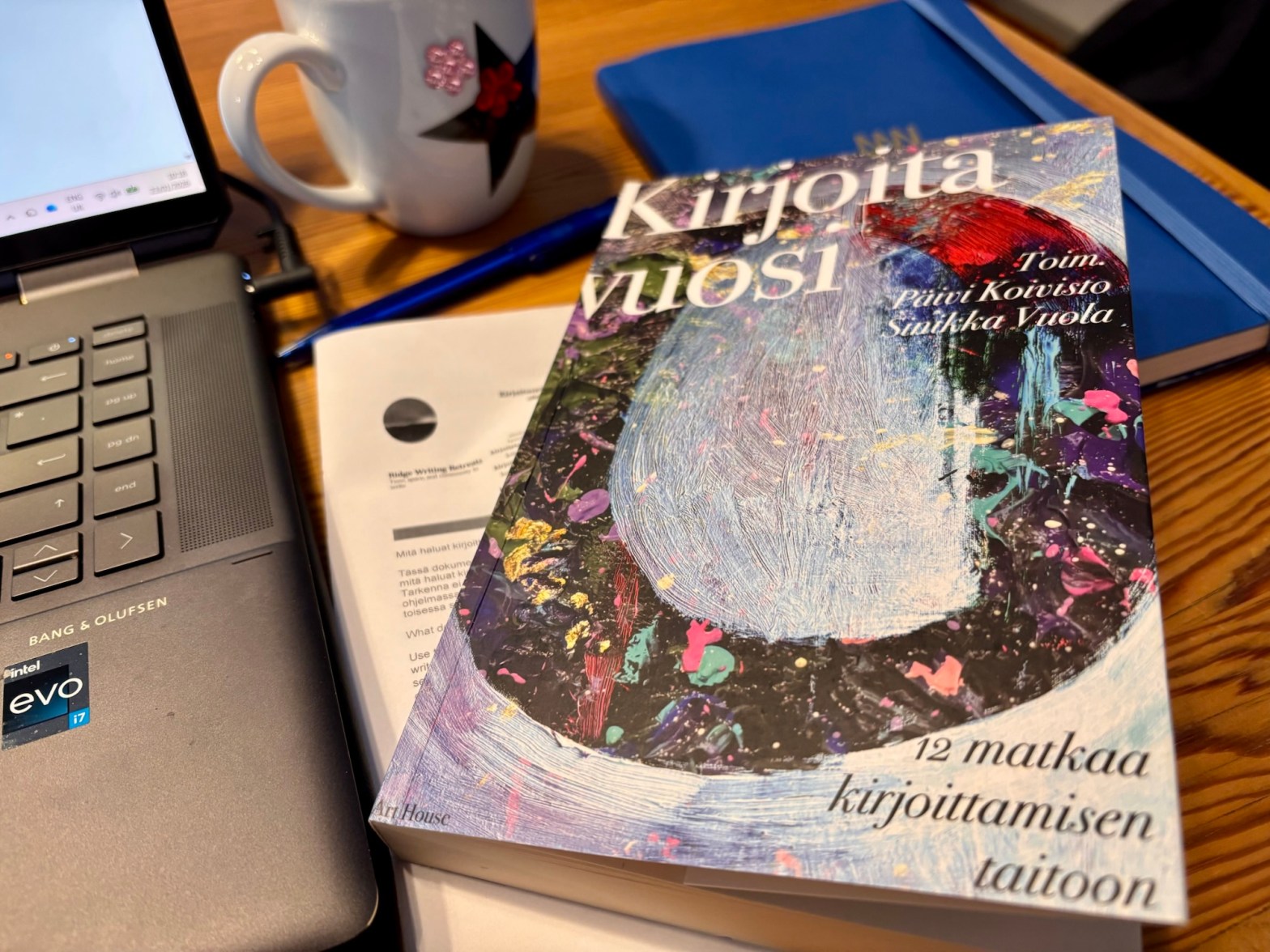
Kirjoita vuosi (“Write a year”, Art House 2025) edited by Sinikka Vuola and Päivi Koivisto, is an accessible guide for writers. If you’d like to extend the depth and range of your writing skills and want help to commit to writing regularly, this could be the book for you. It is like a writing course that lasts a whole year, that anyone can follow at home.
A different Finnish writer takes a fresh approach each month. Together, they share a huge range of experience, not only in different genres but also in teaching and training others. The exercises should suit both beginners and more experienced writers.
The aim is to get into a routine, to get over the fear of starting. It doesn’t matter if what you produce isn’t perfect at first, the main thing is to get something down on paper. That’s what the chapter for January is all about. Pauliina Vanhatalo has written nonfiction books and 12 novels, so she’s started many times.
Changing points of view is the theme for February, with YA and children’s author Siri Kolu.
In March, it’s time to do your research, and think about the archives or other material you could use. Anneli Kanto’s work is wide ranging, from historical novels to TV scripts.
What if you did a different writing exercise every single day? Poet and essayist Sinikka Vuola gives you 30 for April.
Worldbuilding is the theme for May, with speculative fiction author Anne Leinonen.
In June crime writer Tapani Bagge shows you how to plot out the perfect plot.
Marko Hautala, in his own words “not the Finnish Steven King”, helps you create tension in your story in July.
By August you might need a bit of distance from your text, and Matti Kangaskoski gives you the tools to get there. As a philosopher, he’ll help you think about your own philosophy of writing.
September is time to hone poetic techniques, with Johanna Venho, who writes both novels and poetry.
In October, poet Henriikka Tavi looks at how focusing on physicality and the body can help you create rhythm and movement in your work.
Throw yourself into the creative process in November, to balance out all that planning back in June. Monika Fagerholm, who won last year’s Finlandia prize for the best novel, shows you how.
The essay balances creativity and nonfiction; try a new way into it in December with expert essayist Silvia Hosseini.
I was pleased to see that I’ve read nearly all the women writers in this collection, but none of the men. I hope that reading their approaches will encourage me to read their work, as I’ve got a lot out of writing advice from authors I admire, such as Ursula le Guin.
If you want to write a year with me, I’ll be working through the book myself in my Write on Wednesday online sessions and at my writing retreats. I started with starting on my January writing retreat, thinking about why I write at all. As someone who thrives on social writing, I know I’m not going to get to December without a bit of company. So do join me!
You can do it. You just have to start.
Exercise 1 in Chapter 1 is to make a list of what you need to do first:
Pack your writing tools
Get dressed for the place you are going to write in
Go there
Open your laptop or notebook
Open the file or turn to a new page
Write anything, perhaps “anything,” or “I don’t want to write.”
Write another phrase
You’ve started! Keep going…
new retreat dates – seuraavat retriitit
 Ridge Writing Retreats