
This summer holiday, I finished the Helsinki libraries reading challenge for 2025 (Helmet means “Helsinki metropolitan area” by the way, not a biker’s or knight’s headgear). At new year, I had decided to face my chronic TBR problem and stop buying new books until I had read some I already have. So I pulled them off the waiting-to-read shelf and arranged them into the challenge categories: 1 is top left, 50 is bottom right, then just a library card as a librarian had to recommend it.

Where did they all come from? The only e-book, I had preordered, and since then I have stopped buying from Amazon. Some books I had bought myself, like clothes, thinking I’d fit into them someday or look good in them (if you read Finnish, see the brilliant Eleonoora Riihinen on this). Others were gifts from lovely people, but I had other lovely things to read and never quite got round to them. Some books came on subscription from And Other Stories or Fitzcarraldo. So I had chosen the publisher, but not the text. The blue “new title” (uutuus) stickers are from the library. You could say I hadn’t really chosen those, because I’d most likely read a review and decided to order them. One is my dad’s – with tiny marginal notes, he was a literature lecturer. A couple are book club reads.
Language wise, 18 books are in Finnish, including translations from the neighbours’ languages: Danish, Livonian, Russian, and Swedish. Only one in German, and one in French (it was very short and I did use a dictionary). Five in Polish. So 25, half, were in English (including translations from Spanish and Kannada). I think I read more in Polish and German than that, and more in translation, but those are the stats!
At this point, reasonably, you might be wondering what all this has to do with writing. Well, they say that to write, you have to read, and it’s true. Here are ten of those 50 challenge reads that made me want to write.
2. Fantasy book: Thomas More’s Utopia is the OG for this genre. Our dreams of the perfect world have changed in half a millennium, but to get a great idea across, it still works to tell a story.
3. The main character of the book is younger than you: In Valoa valoa valoa, Vilja-Tuulia Huotarinen plays with the writing advice given to aspiring novelists and talks directly to YOU, THE READER.
8. The main colour of the book cover is green: Hanna Videen’s The Deorhord, like the Wordhord before it, brims with knowledge of where Old English words come from, how they connect, and when they resonate.
13. The author has worked in the library: Ursula Le Guin did. I waited to read The Found and the Lost when I needed some comfort, but her worldbuilding is not cuddly – it’s inspiring and gives you strength.
22. The characters are on holiday: Women Writing About Walking takes you to some classic English holiday destinations. More importantly, it makes you want to observe everything around you and write it down.
26. The book includes a chosen family: Audre Lorde’s Your Silence Will Not Protect You brings her work to a new generation. It reminded me you cannot ignore the context where you are writing.
32. The book is related to Tove Jansson (80 years of Moomins 2025): her Reilua Pelia, or Fair Play, is about a writer’s life with an artist. It was the perfect antidote to The Love Story of the Century (read for no. 31) showing how a couple can live shared creative lives.
34. The book has a famous building in it (Year of Built Heritage 2025): Michał Rusinek’s Nic zwyczajnego has Stockholm City Hall. He was Wisława Szymborska’s secretary when she won the Nobel, and shows how a big award affects your writing.
40. In the book, time or a clock/watch plays an important role: in Solvej Balle’s On the Calculation of Volume, time messes with your head. As I wrote when I read it, not winning the Booker can only be good for her writing the rest of the series.
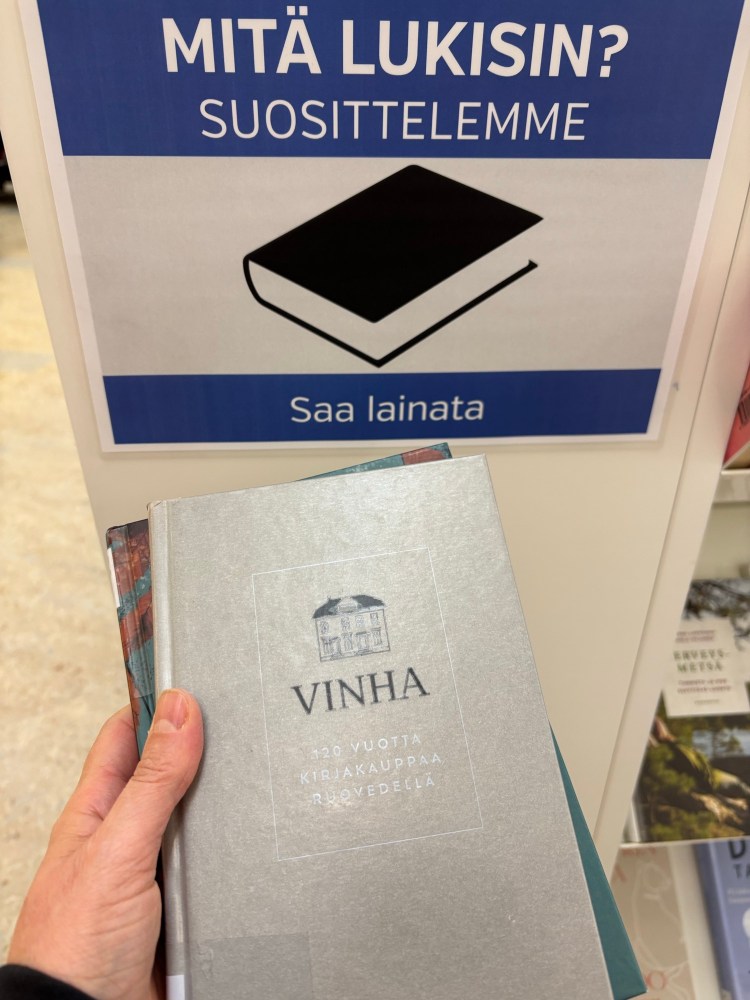
50. A book recommended by a library employee: I found Vinha – 120 vuotta kirjakauppaa Ruovedellä on the city librarians’ recommendation shelf. It shows how the bookselling industry has changed, and is an ode to a centenarian bookshop.
If you’re doing this or any other reading challenge, I’d love to hear which books made you think about writing, or made you want to write. Or what categories inspired you to read – and write – a little differently.
new retreat dates – seuraavat retriitit
 Ridge Writing Retreats