Recently I learned that a university had proposed using an AI chatbot to write research funding applications. The writers would have to check whether the bot had hallucinated the guidelines. This led to flurry on social media. Some scholars saw it as a cynical cost-cutting, productivity-boosting exercise. What I don’t know is whether the bots are yet reading the grant proposals. Elsewhere I have heard the advice to “write like AI” so “AI will approve your application.”
Rather than falling into a slough of despond – or slop – about this, I’d like to share a few things I’ve noticed when reading these applications myself. I copyedit a lot of them, for both national and EU research funding, for academics at different institutions. This means I notice what support scholars are getting to write these texts. And what support they are not getting. Many institutions shower prospective applicants with the attention of a good antenatal unit. Some get initial appointments, follow-up appointments, scans… others do not.
The stakes are high. Researchers who have funding might have better access to all sorts of other resources. (As one example, the Jyväskylä branch of the national archives says one ground for accessing their self-service is doing funded research.) For a high-stakes application, here are five relatively low-stakes things you can do. I spot these in almost all applications I edit.*
Give yourself time. It takes longer than you think. When I edit, I always include a round of feedback. Some researchers pay extra for more rounds. That takes time. Of course you can click “accept all” and upload. But if you want to check my suggestions, respond to comments, and wait for me to hone the text once more, you need to factor that in. So start early. (I’m sure you tell your students this. The longer the gaps between revision rounds, the better the text.)
Speak freely. When you respond to a comment, the language is often more natural. It sounds like you talking. You get to the point faster. Often, you’ll be commenting in another language we share and I can translate that into English. Very often, I will suggest moving your reply to my comment into the main text. You’ve made your point better there, as you sound like you. ( I’ve seen this called rubber duck debugging, but I’m not sure about being the duck!)
Get the specs right. Some questions on grant application forms are always similar. Where do you meet UN sustainable development goals? How do you handle data protection? What about risk assessment and ethical approval? If you have a good, concise, base text, you can tweak, reuse, and repeat. Some universities help you write these, but you need to make them your own. (I’ve edited so many I could write them with my eyes shut – but you don’t want sleepy readers.)
Remember your readers. Yes, it’s hell to write these, but it’s not heaven to read them. I can still picture my lecturer father in his armchair marking undergraduate essays, peanuts and whisky to hand. I may misremember the whisky, but now I can imagine he needed it. That helps me try to at least entertain a little in texts that are going to be assessed. You’re interested, are they? (Not all-dancing distraction, but you can include fun aspects to reach a wider audience.)
Look in the mirror before you go out. I don’t always remember to do this and can cultivate the English eccentric look. But for your application doesn’t need a holey jumper or messy hair. Smooth it over. Break up wall-to-wall text with white space, bullet points, and graphics. Bold key questions, minimize acronyms, explain terms people outside your niche won’t know. And it’s ok to restate key points, so your reader feels like you, and they, know what you’re doing. (Your reader will thank you for it. If it’s easier to read, it’s easier to believe in, and to approve.)
It can be existentially stressful to write funding applications. And I’m here to help! But writing for a reader can make it less stressful. Maybe the next one will be a bit easier for you to write.
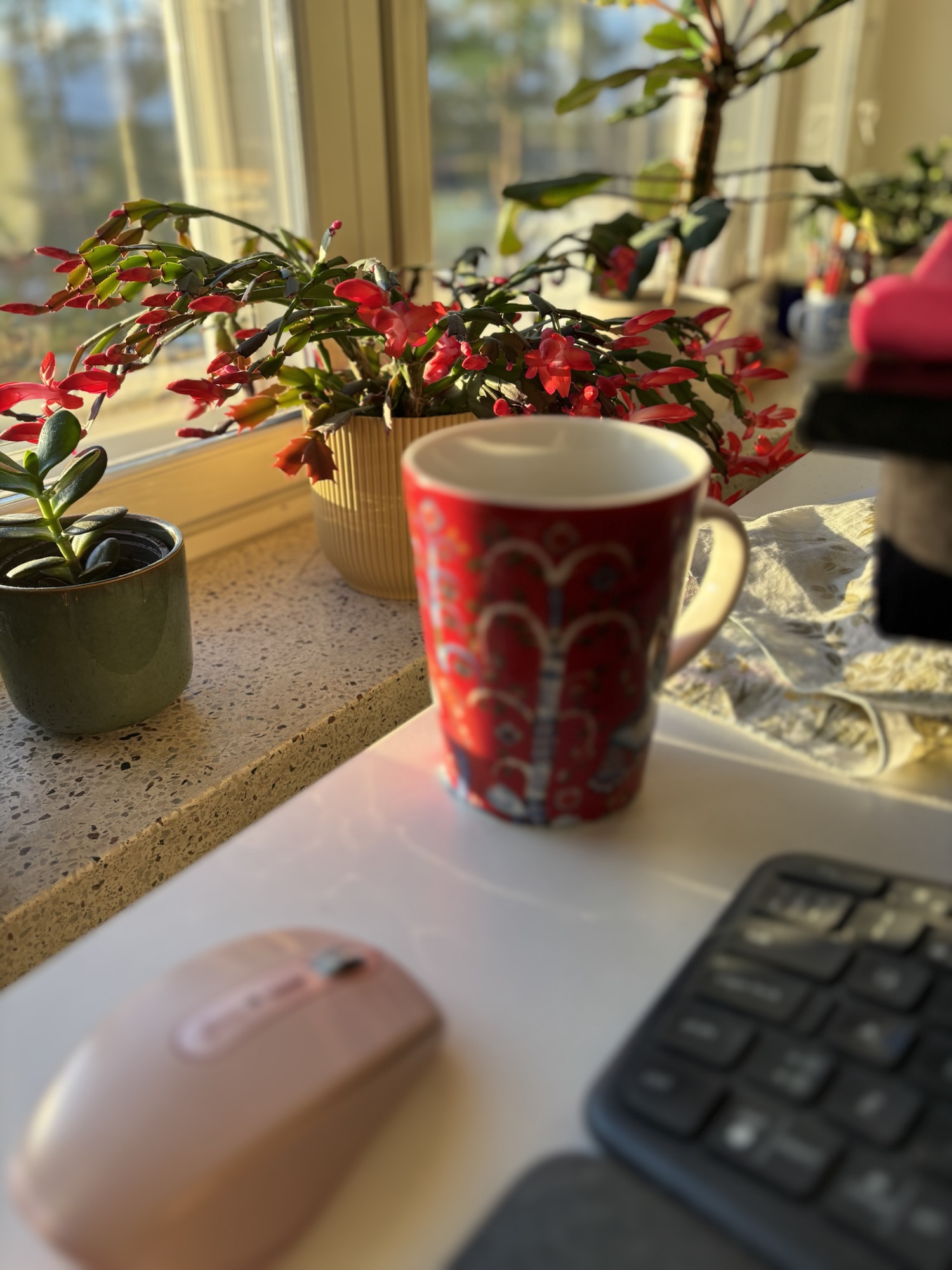
* photo from my desk, where I edit and write, taken on my last online writing retreat.
new retreat dates – seuraavat retriitit
 Ridge Writing Retreats